This is a solution to a problem no one asked about. While the floatation effects and shock absorption properties may be marginally better than the smaller solid wheel, it is less convenient to use in dirty environments, especially in those with cement.
I think a better idea that Sir Dyson could have delved into, if he wanted to build the holy grail of barrows, was to make the ball smaller, and pivot it in such a fashion that it rolls in any direction. I’m thinking of something akin to a computer mouse ball with lesser friction.
Think about it.
A wheel and axle only goes one way. It can be made to turn in the direction you want, but you would need some redundant moves in between to do so. Think about the same scenario when you have a heavy load. The redundant moves then essentially multiply. Its not very convenient, is it?
The only additional component it would need would be a foldable stand that can be locked in place to load the barrow.
If I had any money, I would like to bank-roll Ron.
The issue with the mouse type omni-directional roller is retention of the roller ball and ground clearance.
To gain the purchase necessary to contain the ball it needs to be near or beyond the center point of the ball the mouse design is actually well beyond centerline and thus eliminates the utility as a load bearing and dispensing fulcrum as it would have very little effective ground clearance.
The best solution I can think of off the cuff would be a conical retainer for the ball-wheel much like that of a ball point pen.
That might give you the clearance and maneuverability for true functionality.
I love the ball-barrow, and have kept my large galvanized one in use until this year, when I finally gave up trying to inflate the perished ball.
We used to have one of the small plastic ball-barrows, which were much less robust, and could not be fitted with an extension to make them suitable for collecting low-density materials such as hedge-clippings.
Both forms had the virtue of being very easy to steer, and neither sank into soft ground (that’s not just an aesthetic matter; if a wheel sinks in, the barrow becomes hard to get moving – ball-barrows move away with minimal effort).
I’d rate the galvanized version 5* for design and 4* for build-quality, and the plastic version 4* and 2*
This design of barrow is fantastic for any equine property…why hasn’t someone continued to supply these…i have not seen the galvanised ones, but any design just on the ball is perfect and as big a bucket as possible.
Regarding the omni-directional ballbarrow… wouldn’t work.
Imagine trying to push a heavy load across an un-even or un-level surface. The barrow would head in whichever direction it chooses regardless of operator input. If you have a very heavy load, better hold on tight cause you’d be going for a ride.
A wheel and axle is the only way to build a wheel barrow. A spherical wheel allows you to tip the barrow at any angle , even to the sides, (not just to the front like the ordinary types) with a reasonable ammount of control.
I’ve just got a decent sized garden again after a 10 year break, decided to buy a barrow and can’t believe they don’t make them any more! I wore two of them out years ago, but still think they are the best for a lady moving stuff like compost about. Probably not for mixing concrete, but they are not aimed at the building trade!
We have had one of these for about 25 years – it has been incredibly useful, and the ball has given NO troble in all that time. The plastic barrow part has split, been repaired, and split again, repaired again (our fault – over use) and has finally given up the ghost. Would do almost anything for another!
There seems to be something called a NuBarro which may be similar, so investigating that.
The ball did indeed work for reduced pressure on soft ground – especially sand. It was also very easy to steer, much better than any more complex idea involving castors or additional suspension rollers (like a mouse). Its one drawback was that it wouldn’t go in a straight line on concrete – yet there was a simple fix for this, stapling a narrow tyre of old bike tyre around the equator of the ball. This made it a narrow wheel barrow on hard surfaces, without affecting its soft ground performance.
I wouldn’t use one for building work, but they were good for garden use and I imagine with horses too.
I honestly have no idea what the advantage is here. Over a hard plastic wheel or something? sure, but who uses something like that? This has no advantage over a pneumatic tire. They can be tilted and maintain grip easily on a lateral slope. I guess think about a motorcycle cornering– somehow they manage to lean quite far without needing a dyson ball for a tire. His marketing gimmicks are irritating. I also thought that, yes, if this were omnidirectional (though I don’t know how you could do that without some kind of very heavy cup that, itself, had a caged bearing in it.. hmm… okay, that might work. Even if it did work, the ball would, essentially, have to take twice the wear. The other would be a kind of universal joint where the through axle swiveled, but why? so you could more easily lose control of a load while going across a sloped surface? Nah, the tire is still the best.
I want to gt hold of a dyson ballbarrow. My garden is quite small but often have to move cattings etc.
Please advise
It’s kind of cute how people who have actually used one say it works great, while people who hasn’t keep making up arguments for why it shouldn’t…
I just brought an old one, some of the frame is rotted and I intend to get it repaired but I need to remove the ball before I can do this. Does anybody how any idea how to do this?
cannot find a replacement for my existing ball wheelbarrow of 20 years old
Ballbarrow is so not chronic. My nan has more articulation than it 😉
Has anyone got an old spare Dyson trolley ball they would like to sell?
Does anyone know how to repair a small air leak in a Dyson trolley ball?
Desperate….!!!!
My father had one of these when I was a child. Where could I get one now they were fantastic
My ball developed a crack and of course the ball went flat and was unusable. I bought some “Good Stuff” and filled it up with the foam. works great. “Good Stuff” is used in construction to fill in cracks and opening in the foundation and framing. One can purchase “Good Stuff” at any hardware store. Be sure you have the ball on the Ballbarrow before you fill it up otherwise you will not be able to get it back on the mounts of the Ballbarrow.
had one for years, the problem no one has mentioned is that the weight of whatever is in the barrow is behind the wheel.
thus the weight is nearly all on the handles, this makes anything other than grass cuttings extremely hard work to push.
used it for only light stuff until the wheel sprung a leak and the hopper plastic degraded and cracked.
a conventional barrow put most of the weight on the wheel, so is lighter and equally manoeuvrable in my experience.
I have recently aquired a childs ride on toy with 2 of these balls for its wheels front and back. It looks great and there seems to be a new one now from Germany available but I know nothing about where this was made. Its from the 1970s and has a seat located similar to the shuttle used in the film the running man only with a wheel front and back, looks cool. Any info would be great.
Fantastic ballbarrow that I have owned since 1978. It is my yard companion. Are they still manufactured? I want another.
I would not be without this. Won in an auction 1978. Still using and want another. Are they still sold, if so, where?
Where can I buy a new BallBarrow
Have had same one for 10 years would like another. Best wheel / ball barro I ever had.
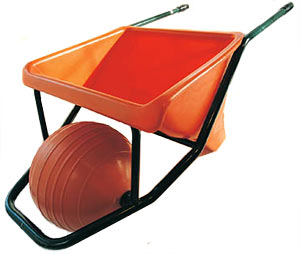
Ah. A solution in search of a problem.
This is a solution to a problem no one asked about. While the floatation effects and shock absorption properties may be marginally better than the smaller solid wheel, it is less convenient to use in dirty environments, especially in those with cement.
I think a better idea that Sir Dyson could have delved into, if he wanted to build the holy grail of barrows, was to make the ball smaller, and pivot it in such a fashion that it rolls in any direction. I’m thinking of something akin to a computer mouse ball with lesser friction.
Think about it.
A wheel and axle only goes one way. It can be made to turn in the direction you want, but you would need some redundant moves in between to do so. Think about the same scenario when you have a heavy load. The redundant moves then essentially multiply. Its not very convenient, is it?
The only additional component it would need would be a foldable stand that can be locked in place to load the barrow.
If I had any money, I would like to bank-roll Ron.
The issue with the mouse type omni-directional roller is retention of the roller ball and ground clearance.
To gain the purchase necessary to contain the ball it needs to be near or beyond the center point of the ball the mouse design is actually well beyond centerline and thus eliminates the utility as a load bearing and dispensing fulcrum as it would have very little effective ground clearance.
The best solution I can think of off the cuff would be a conical retainer for the ball-wheel much like that of a ball point pen.
That might give you the clearance and maneuverability for true functionality.
I love the ball-barrow, and have kept my large galvanized one in use until this year, when I finally gave up trying to inflate the perished ball.
We used to have one of the small plastic ball-barrows, which were much less robust, and could not be fitted with an extension to make them suitable for collecting low-density materials such as hedge-clippings.
Both forms had the virtue of being very easy to steer, and neither sank into soft ground (that’s not just an aesthetic matter; if a wheel sinks in, the barrow becomes hard to get moving – ball-barrows move away with minimal effort).
I’d rate the galvanized version 5* for design and 4* for build-quality, and the plastic version 4* and 2*
This design of barrow is fantastic for any equine property…why hasn’t someone continued to supply these…i have not seen the galvanised ones, but any design just on the ball is perfect and as big a bucket as possible.
Regarding the omni-directional ballbarrow… wouldn’t work.
Imagine trying to push a heavy load across an un-even or un-level surface. The barrow would head in whichever direction it chooses regardless of operator input. If you have a very heavy load, better hold on tight cause you’d be going for a ride.
A wheel and axle is the only way to build a wheel barrow. A spherical wheel allows you to tip the barrow at any angle , even to the sides, (not just to the front like the ordinary types) with a reasonable ammount of control.
I’ve just got a decent sized garden again after a 10 year break, decided to buy a barrow and can’t believe they don’t make them any more! I wore two of them out years ago, but still think they are the best for a lady moving stuff like compost about. Probably not for mixing concrete, but they are not aimed at the building trade!
We have had one of these for about 25 years – it has been incredibly useful, and the ball has given NO troble in all that time. The plastic barrow part has split, been repaired, and split again, repaired again (our fault – over use) and has finally given up the ghost. Would do almost anything for another!
There seems to be something called a NuBarro which may be similar, so investigating that.
The ball did indeed work for reduced pressure on soft ground – especially sand. It was also very easy to steer, much better than any more complex idea involving castors or additional suspension rollers (like a mouse). Its one drawback was that it wouldn’t go in a straight line on concrete – yet there was a simple fix for this, stapling a narrow tyre of old bike tyre around the equator of the ball. This made it a narrow wheel barrow on hard surfaces, without affecting its soft ground performance.
I wouldn’t use one for building work, but they were good for garden use and I imagine with horses too.
I honestly have no idea what the advantage is here. Over a hard plastic wheel or something? sure, but who uses something like that? This has no advantage over a pneumatic tire. They can be tilted and maintain grip easily on a lateral slope. I guess think about a motorcycle cornering– somehow they manage to lean quite far without needing a dyson ball for a tire. His marketing gimmicks are irritating. I also thought that, yes, if this were omnidirectional (though I don’t know how you could do that without some kind of very heavy cup that, itself, had a caged bearing in it.. hmm… okay, that might work. Even if it did work, the ball would, essentially, have to take twice the wear. The other would be a kind of universal joint where the through axle swiveled, but why? so you could more easily lose control of a load while going across a sloped surface? Nah, the tire is still the best.
I want to gt hold of a dyson ballbarrow. My garden is quite small but often have to move cattings etc.
Please advise
It’s kind of cute how people who have actually used one say it works great, while people who hasn’t keep making up arguments for why it shouldn’t…
I just brought an old one, some of the frame is rotted and I intend to get it repaired but I need to remove the ball before I can do this. Does anybody how any idea how to do this?
cannot find a replacement for my existing ball wheelbarrow of 20 years old
Ballbarrow is so not chronic. My nan has more articulation than it 😉
Has anyone got an old spare Dyson trolley ball they would like to sell?
Does anyone know how to repair a small air leak in a Dyson trolley ball?
Desperate….!!!!
My father had one of these when I was a child. Where could I get one now they were fantastic
My ball developed a crack and of course the ball went flat and was unusable. I bought some “Good Stuff” and filled it up with the foam. works great. “Good Stuff” is used in construction to fill in cracks and opening in the foundation and framing. One can purchase “Good Stuff” at any hardware store. Be sure you have the ball on the Ballbarrow before you fill it up otherwise you will not be able to get it back on the mounts of the Ballbarrow.
had one for years, the problem no one has mentioned is that the weight of whatever is in the barrow is behind the wheel.
thus the weight is nearly all on the handles, this makes anything other than grass cuttings extremely hard work to push.
used it for only light stuff until the wheel sprung a leak and the hopper plastic degraded and cracked.
a conventional barrow put most of the weight on the wheel, so is lighter and equally manoeuvrable in my experience.
I have recently aquired a childs ride on toy with 2 of these balls for its wheels front and back. It looks great and there seems to be a new one now from Germany available but I know nothing about where this was made. Its from the 1970s and has a seat located similar to the shuttle used in the film the running man only with a wheel front and back, looks cool. Any info would be great.
Fantastic ballbarrow that I have owned since 1978. It is my yard companion. Are they still manufactured? I want another.
I would not be without this. Won in an auction 1978. Still using and want another. Are they still sold, if so, where?
Where can I buy a new BallBarrow
Have had same one for 10 years would like another. Best wheel / ball barro I ever had.